


Page 21 - Construction_Opportunities_April_2026
P. 21
COVER STORY
                                                                                          GUEST ARTICLE
                                                                                                                SPOTLIGHT


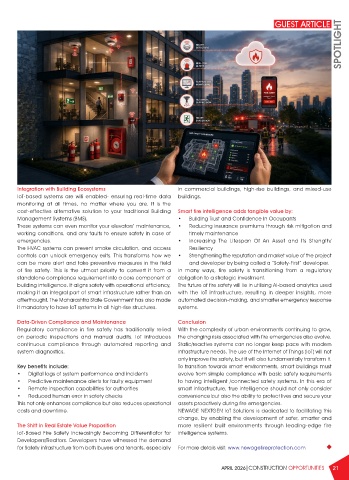
       Integration with Building Ecosystems                in commercial buildings, high-rise buildings, and mixed-use
       IoT-based systems are wifi enabled- ensuring real-time data   buildings.
       monitoring at all times, no matter where you are. It is the
       cost-effective alternative solution to your traditional Building   Smart fire intelligence adds tangible value by:
       Management Systems (BMS).                           •   Building Trust and Confidence In Occupants
       These systems can even monitor your elevators’ maintenance,   •   Reducing insurance premiums through risk mitigation and
       working conditions, and any faults to ensure safety in case of   timely maintenance
       emergencies.                                        •   Increasing The Lifespan Of An Asset and Its Strength/
       The HVAC systems can prevent smoke circulation, and access   Resiliency
       controls can unlock emergency exits. This transforms how we   •   Strengthening the reputation and market value of the project
       can be more alert and take preventive measures in the field   and developer by being called a “Safety-First” developer.
       of fire safety. This is the utmost priority to convert it from a   In many ways, fire safety is transitioning from a regulatory
       standalone compliance requirement into a core component of   obligation to a strategic investment.
       building intelligence. It aligns safety with operational efficiency,   The future of fire safety will lie in utilising AI-based analytics used
       making it an integral part of smart infrastructure rather than an   with the IoT infrastructure, resulting in deeper insights, more
       afterthought. The Maharashtra State Government has also made   automated decision-making, and smarter emergency response
       it mandatory to have IoT systems in all high-rise structures.   systems.

       Data-Driven Compliance and Maintenance              Conclusion
       Regulatory compliance in fire safety has traditionally relied   With the complexity of urban environments continuing to grow,
       on periodic inspections and manual audits. IoT introduces   the changing risks associated with fire emergencies also evolve.
       continuous compliance through automated reporting and   Static/reactive systems can no longer keep pace with modern
       system diagnostics.                                 infrastructure needs. The use of the Internet of Things (IoT) will not
                                                           only improve fire safety, but it will also fundamentally transform it.
       Key benefits include:                               To transition towards smart environments, smart buildings must
       •   Digital logs of system performance and incidents   evolve from simple compliance with basic safety requirements
       •   Predictive maintenance alerts for faulty equipment   to having intelligent /connected safety systems. In this era of
       •   Remote inspection capabilities for authorities   smart infrastructure, true intelligence should not only consider
       •   Reduced human error in safety checks            convenience but also the ability to protect lives and secure your
       This not only enhances compliance but also reduces operational   assets proactively during fire emergencies.
       costs and downtime.                                 NEWAGE NEXTGEN IoT Solutions is dedicated to facilitating this
                                                           change, by enabling the development of safer, smarter and
       The Shift in Real Estate Value Proposition          more resilient built environments through leading-edge fire
       IoT-Based Fire Safety Increasingly Becoming Differentiator for   intelligence systems.
       Developers/Realtors. Developers have witnessed the demand
       for Safety infrastructure from both buyers and tenants, especially   For more details visit: www.newagefireprotection.com


                                                                         APRIL 2026|CONSTRUCTION OPPORTUNITIES  21

