


Page 12 - Construction_Opportunities_March_2026
P. 12
VER STOR
       COVER STORY
       CO
                       Y


       Short-Term Moderation, Structural Reset             billion by 2034, growing at a more moderate pace of around
       Despite strong structural drivers, the industry is currently navigating   3–4% CAGR, according to Research & Markets. India, therefore,
       a phase of moderation—but this is less a slowdown and more   stands out as a high-growth outlier within a relatively mature
       a reset. ICRA’s projection of 3–5% near-term growth through   global  landscape.  Within  India,  demand  is  no  longer  driven
       FY2027, following a subdued FY2026, reflects a convergence of   purely by volume. It is being shaped by faster project timelines;
       factors: delayed project awards, execution bottlenecks, extended   higher quality standards; and greater scrutiny on lifecycle costs.
       monsoons, and the transition to stricter emission norms. At the   This is pushing contractors toward more advanced equipment—
       same time, input cost volatility—particularly in steel, bitumen, and   particularly in road construction segments such as asphalt pavers,
       fuel—is compressing margins across contractors.     compactors, and batching plants.
       But beneath these pressures lies a more fundamental shift. The   This shift toward productivity and lifecycle efficiency is already
       industry  is  moving  from  a  volume-led  expansion  cycle  to  an   playing out on the ground. In road projects across hilly and remote
       efficiency-led execution model. Capital is no longer scarce—  regions, contractors are rethinking one of the most persistent
       execution  capability is.  In this environment, even temporary   inefficiencies in execution—material logistics. Instead of sourcing
       moderation is forcing a recalibration: tighter cost control, better   aggregates from crushing plants located 25–30 km away, they are
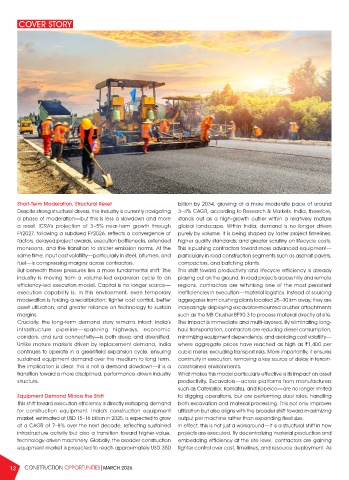
       asset utilization, and greater reliance on technology to sustain   increasingly deploying excavator-mounted crusher attachments
       margins.                                            such as the MB Crusher BF90.3 to process material directly at site.
       Crucially,  the  long-term  demand  story  remains  intact.  India’s   The impact is immediate and multi-layered. By eliminating long-
       infrastructure pipeline—spanning highways, economic   haul transportation, contractors are reducing diesel consumption,
       corridors, and rural connectivity—is both deep and diversified.   minimizing equipment dependency, and avoiding cost volatility—
       Unlike mature markets driven by replacement demand, India   where aggregate prices have reached as high as `1,400 per
       continues to operate in a greenfield expansion cycle, ensuring   cubic meter, excluding transport risks. More importantly, it ensures
       sustained equipment demand over the medium to long term.   continuity in execution, removing a key source of delay in terrain-
       The implication is clear: this is not a demand slowdown—it is a   constrained environments.
       transition toward a more disciplined, performance-driven industry   What makes this model particularly effective is its impact on asset
       structure.                                          productivity. Excavators—across platforms from manufacturers
                                                           such as Caterpillar, Komatsu, and Kobelco—are no longer limited
       Equipment Demand Mirrors the Shift                  to digging operations, but are performing dual roles, handling
       This shift toward execution efficiency is directly reshaping demand   both excavation and material processing. This not only improves
       for construction equipment. India’s construction equipment   utilization but also aligns with the broader shift toward maximizing
       market, estimated at USD 15–16 billion in 2025, is expected to grow   output per machine rather than expanding fleet size.
       at a CAGR of 7–8% over the next decade, reflecting sustained   In effect, this is not just a workaround—it is a structural shift in how
       infrastructure activity but also a transition toward higher-value,   projects are executed. By decentralizing material production and
       technology-driven machinery. Globally, the broader construction   embedding efficiency at the site level, contractors are gaining
       equipment market is projected to reach approximately USD 350   tighter control over cost, timelines, and resource deployment. As


    12   CONSTRUCTION OPPORTUNITIES|MARCH 2026

