


Page 16 - Construction_Opportunities_February_2026
P. 16
11 th
       CO  VER STOR    Y                               ANNIVERSARY
       COVER STORY
                                                         ITION
                                                         ITION
                                                         ED
                                                         ED
                                                         ED ITION


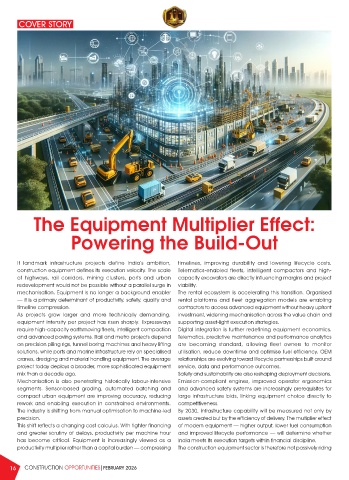
            The Equipment Multiplier Effect:


                        Powering the Build-Out


       If landmark infrastructure projects define India’s ambition,   timelines, improving durability and lowering lifecycle costs.
       construction equipment defines its execution velocity. The scale   Telematics-enabled fleets, intelligent compactors and high-
       of highways, rail corridors, mining clusters, ports and urban   capacity excavators are directly influencing margins and project
       redevelopment would not be possible without a parallel surge in   viability.
       mechanisation. Equipment is no longer a background enabler   The rental ecosystem is accelerating this transition. Organised
       — it is a primary determinant of productivity, safety, quality and   rental platforms and fleet aggregation models are enabling
       timeline compression.                               contractors to access advanced equipment without heavy upfront
       As projects grow larger and more technically demanding,   investment, widening mechanisation across the value chain and
       equipment intensity per project has risen sharply. Expressways   supporting asset-light execution strategies.
       require high-capacity earthmoving fleets, intelligent compaction   Digital integration is further redefining equipment economics.
       and advanced paving systems. Rail and metro projects depend   Telematics, predictive maintenance and performance analytics
       on precision piling rigs, tunnel boring machines and heavy lifting   are  becoming  standard,  allowing  fleet  owners  to  monitor
       solutions, while ports and marine infrastructure rely on specialised   utilisation, reduce downtime and optimise fuel efficiency. OEM
       cranes, dredging and material handling equipment. The average   relationships are evolving toward lifecycle partnerships built around
       project today deploys a broader, more sophisticated equipment   service, data and performance outcomes.
       mix than a decade ago.                              Safety and sustainability are also reshaping deployment decisions.
       Mechanisation is  also penetrating  historically  labour-intensive   Emission-compliant engines, improved operator ergonomics
       segments. Sensor-based grading, automated batching and   and advanced safety systems are increasingly prerequisites for
       compact urban equipment are improving accuracy, reducing   large infrastructure bids, linking equipment choice directly to
       rework and enabling execution in constrained environments.   competitiveness.
       The industry is shifting from manual optimisation to machine-led   By 2030, infrastructure capability will be measured not only by
       precision.                                          assets created but by the efficiency of delivery. The multiplier effect
       This shift reflects a changing cost calculus. With tighter financing   of modern equipment — higher output, lower fuel consumption
       and greater scrutiny of delays, productivity per machine hour   and improved lifecycle performance — will determine whether
       has become critical. Equipment is increasingly viewed as a   India meets its execution targets within financial discipline.
       productivity multiplier rather than a capital burden — compressing   The construction equipment sector is therefore not passively riding


    16   CONSTRUCTION OPPORTUNITIES|FEBRUARY 2026

