


Page 42 - CO_December_2022
P. 42
TICKER TAPE
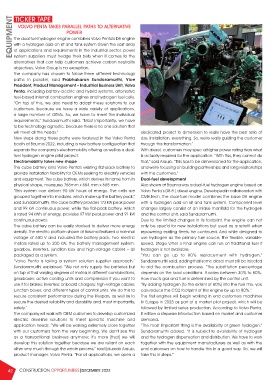
          EQUIPMENT  The dual-fuel hydrogen engine combines Volvo Penta’s D8 engine
             VOLVO PENTA TAKES PARALLEL PATHS TO ALTERNATIVE
                                 POWER

           with a hydrogen add-on kit and tank system Given the vast array
           of applications and requirements in the industrial sector, power
           system suppliers must hedge their bets when it comes to the
           alternatives that can help customers achieve carbon neutrality
           objectives. Volvo Group is no exception.
           The company has chosen to follow three different technology
           paths in parallel, said  Prabhakaran Sundaramurthi, Vice
           President, Product Management – Industrial Business Unit, Volvo
           Penta, including battery-electric and hybrid systems, alternative
           fuel-based internal combustion engines and hydrogen fuel cells.
           “On top of this, we also need to adapt these solutions to our
           customers, because we have a wide variety of applications,
           a large number of OEMs. So, we have to meet the individual
           requirements,” Sundaramurthi said. “Most importantly, we have
           to be technology agnostic, because there is no one solution that
           will meet all the needs.”                           dedicated project to dimension to really have the best ratio of
           New steps along these paths were featured in the Volvo Penta   size, installation, everything. So, we’re really guiding the customer
           booth at Bauma 2022, including a new battery configuration that   through this transformation.”
           expands the company’s electromobility offering as well as a dual-  With diesel, customers may spec a higher power rating than what
           fuel hydrogen engine pilot project.                 is actually required for the application. “With this, they cannot do
           Electromobility takes new shape                     that,” said Araujo. “This has to be dimensioned for the application,
           The cube battery joins Volvo Penta’s existing flat-pack battery to   and we’re focusing on building partnerships and long relationships
           provide installation flexibility for OEMs seeking to electrify vehicles   with the customers.”
           and equipment. The cube battery, which derives its name from its   Dual-fuel development
           physical shape, measures 768mm x 684 mm x 668 mm.   Also shown at Bauma was a dual-fuel hydrogen engine based on
           “This system can deliver 90 kW hours of energy. The cells are   Volvo Penta’s D8 8 L diesel engine. Developed in collaboration with
           grouped together into modules, which make up the battery pack,”   CMB.Tech, the dual-fuel model combines the base D8 engine
           said Sundaramurthi. The cube battery provides 173 kW peak power   with a hydrogen add-on kit and tank system. Component level
           and 99 kW continuous power, while the flat-pack battery, which   changes largely consist of an intake manifold for the hydrogen
           is rated 94 kWh of energy, provides 97 kW peak power and 91 kW   and the control unit, said Sundaramurthi.
           continuous power.                                   Due to the limited changes in its footprint, the engine can not
           The cube battery can be easily stacked to deliver more energy   only be spec’d for new installations but used as a retrofit when
           density. The electric platform shown at Bauma featured a nominal   repowering existing fleets, he continued. And while designed to
           voltage of 600 V and included the battery pack, two electric   use hydrogen as the primary fuel source, the flexible, variable-
           motors rated up to 200 kW, the battery management system,   speed, Stage V/Tier 4 Final engine can run on traditional fuel if
           gearbox, inverters, junction box and high-voltage cables – all   hydrogen is not available.
           packaged as a system.                               “You can go up to 80% replacement with hydrogen,”
           “Volvo Penta is taking a system solution supplier approach,”   Sundaramurthi said, adding that some diesel must still be injected
           Sundaramurthi explained. “We not only supply the batteries but   to aid the combustion process. “The substitution percentage
           on top of that varying degrees of motors in different combinations;   depends on the load conditions. It varies between 30% to 80%.
           gearboxes; active cooling units and compressors if you want to   How much gas and fuel is determined by the control unit.
           use it for brakes; inverters; onboard chargers; high-voltage cables;   “By adding hydrogen (to the extent of 80%) into the fuel mix, you
           junction boxes; and different types of control units. We do this to   can reduce the CO2 footprint of this engine by up to 80%.”
           secure consistent performance during the lifespan, as well as to   The first engines will begin working in end customers machines
           secure the desired reliability and durability and, most importantly,   in Europe in 2023 as part of a market pilot project, which will be
           safety.”                                            followed by limited series production. According to Volvo Penta,
           The company will work with OEM customers to develop customized   it will be a stepwise introduction based on market and customer
           electric driveline solutions to meet specific machine and   demand.
           application needs. “We will be working extremely close together   “The most important thing is the availability of green hydrogen,”
           with our customers from the very beginning. We don’t see this   Sundaramurthi added. “It is subject to availability of hydrogen
           as  a  transactional  business  anymore;  it’s  more  [that]  we will   and the hydrogen dispensation and distribution. We have to work
           develop this solution together because we are reliant on each   together with the equipment manufacturers as well as with the
           other very much through the whole process,” said Eduardo Araujo,   end customers on how to handle this in a good way. So, we will
           product manager, Volvo Penta. “For all applications, we open a   take this in steps.”


        42   CONSTRUCTION OPPORTUNITIES|DECEMBER 2022

